


MOUNTAIN VIEW, CA – What is the financial outlook for HME providers? If you ask Gemini (Google’s AI chatbot), you get words such as “strongly positive” and “steady revenue growth,” but that’s not the whole story.
Gemini immediately taps into research that touts favorable demographics, specifically stating, “The global and U.S. markets are projected to grow at a compound annual growth rate of 6% to 7% over the coming decade—driven by powerful demographic shifts and a systemic push toward decentralized, home-based healthcare.”
An AI chatbot ultimately represents a human consensus, but does that best guess agree with the opinions of our industry experts? “I’m leaning toward true on the financial outlook,” says Rose Schafhauser, exec director for the Midwest Association for Medical Equipment Services & Supplies (MAMES) and Southwest Medical Equipment Suppliers Association (SWMESA). “However, the financial pressures of this industry will definitely continue.”
“The AI predictions aren’t far-off from what we’ve been saying collectively for years,” says Kelly S. Grahovac, general manager, The van Halem Group. “The aging population and wish to age at home are driving factors for a favorable industry future. Add to that the goal to keep patients out of inpatient facilities due to high costs.”

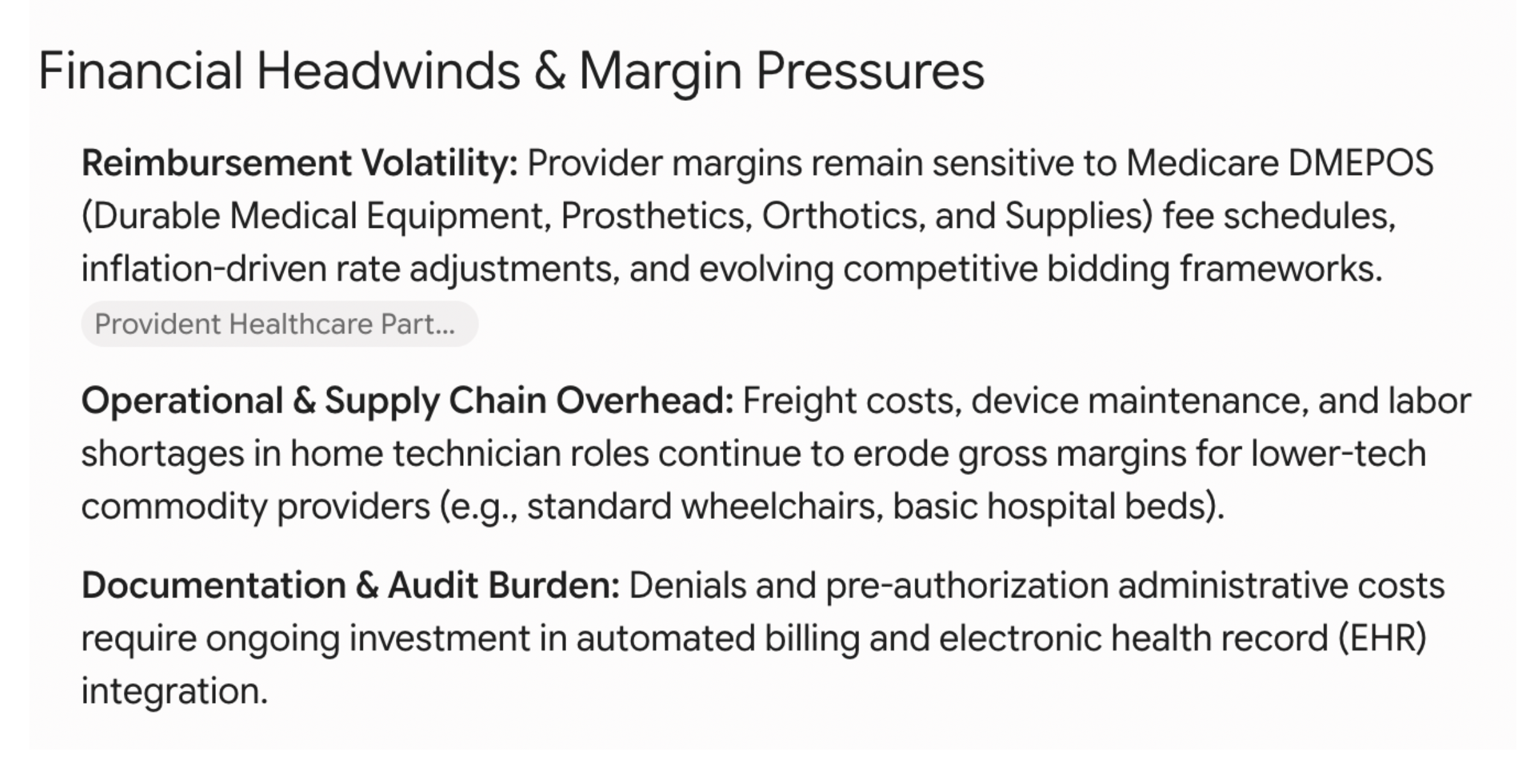
The second part of the Gemini answer claws back some of the optimism with three specific financial headwinds: 1) reimbursement volatility; 2) operational and supply chain overhead; and 3) documentation/audit burden.
 “I could not agree more with the part that mentions reimbursement volatility and documentation/audit burden,” says Wayne van Halem, founder, The van Halem Group. “These will continue to be huge financial headwinds for suppliers—particularly under this administration’s focus on reducing fraud, waste, and abuse. Unfortunately, that often leads to legitimate suppliers getting caught in the crosshairs dealing with denials and overpayments. We have seen a significant uptick in audit activity and it’s across the board with government and commercial payers in the mix. I don’t see this slowing down anytime soon.”
As reported in Medtrade Monday and elsewhere, CMS Administrator Mehmet Oz and Deputy Administrator Kimberly Brandt recently announced that more than 100 fraudulent DME suppliers have been suspended and the Medicare billing privileges of 725 suppliers have been revoked. Brandt added that removing these bad actors “has wiped out the majority of DME fraud in America.”
Does the chatbot think these recent actions will lead to a lightening of the audit burden for DME suppliers in coming months? We asked and Gemini agreed with van Halem, stating a flat “no” and adding: “While removing major bad actors eliminates large-scale, overt fraud schemes, CMS is simultaneously expanding its program integrity enforcement through proactive, technology-driven monitoring rather than scaling back scrutiny.”
 Grahovac confirms that CMS’ use of AI to audit records faster and more frequently will only increase. Can providers deal with the increased scrutiny with technology of their own? Tim Freidel, CEO & founder of DME Flow (a Medtrade exhibitor) is part of a growing movement to bring DME providers into the new tech world in a way that can streamline operations while improving efficiency and compliance.
The “winners” in this scenario will inevitably be pushed to provide better care at lower costs—no easy task. “DMEs across the board are facing the same obstacles,” Freidel says. “However, they are going to affect everyone differently depending on how they choose to approach it.”
The approach for virtually all providers falls under the umbrella of “operating margin pressure” which affects the bottom line and patient care. Manufacturers can be a key part of the equation.
 “Manufacturers can help most by being a true partner in finding cost-effective solutions, not just a vendor selling equipment,” says Chrysalis Ashton, head of Respiratory Clinical Affairs and Industry Relations at Drive Medical, a Medtrade exhibitor. “That includes investing in education and training resources that help providers use products efficiently from day one, so staff aren’t losing time or margin to a learning curve.”
The fates of manufacturers and providers are intertwined, and Ashton calls herself a realistic optimist when pondering the future. “There’s no doubt the DME landscape can feel uncertain at times—reimbursement pressures, rising costs, and staffing challenges are real,” she muses. “Our industry will always be needed. What matters now is whether we, as leaders, keep advocating—for our businesses, our services, and most importantly, our patients.”
Article is certified HUMAN.