

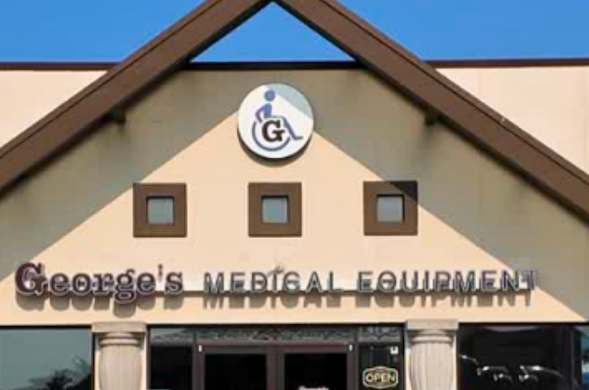
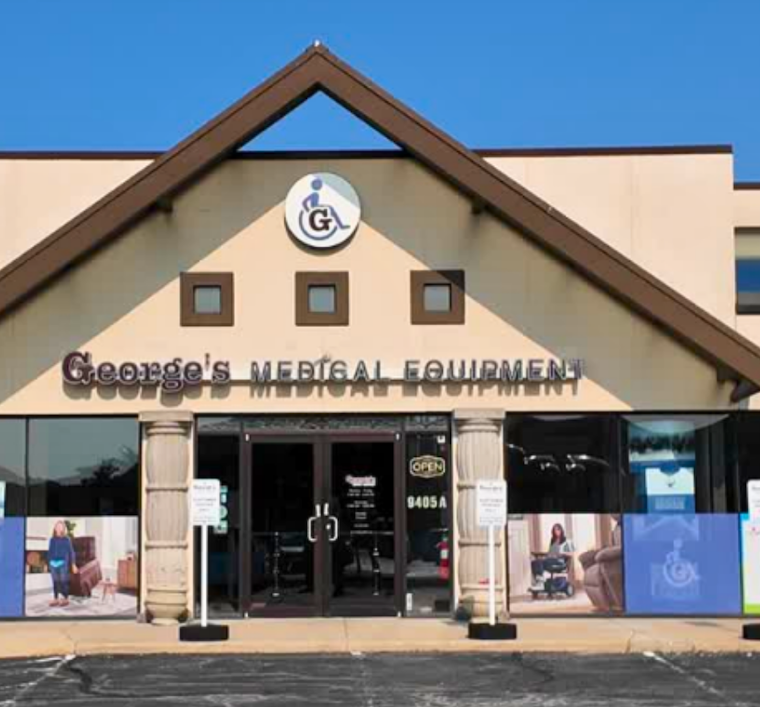
BLUE ASH, OH – George’s Pharmacy & Medical Equipment is a thriving “independent” DME chain, but Butch Martin, executive vice president, is hesitant to call it a regional—mostly because 11 of the dozen DME shops are based in Indiana. The 12th location (pictured) opened two months ago in Blue Ash, Ohio.
The “George’s” operating model is what Martin calls “general line” DME (as well as pharmacy), a set-up that has attracted less acquisition attention from nationals than the respiratory- and mobility-focused independents. “We are an old school one-stop shop,” Martin says. “We have ATPs [assistive technology professionals] and respiratory therapists on staff. We do aging in place and work with two construction crews.”
 According to Martin (pictured left), the decision to leave the Hoosier State cocoon was ultimately based on pure optimism. “I would open five new locations tomorrow if I could,” he enthuses. “Securing the talent needed to run those stores would be the only thing holding us back. Beth Thomas is our manager at the Blue Ash location and she’s been very successful in that Ohio market. She became available, so we hired her.”
Good help has always been difficult to find, but why is it so tough for the HME world? One reason is that it’s highly specialized and the industry is relatively small. “If you had a healthcare pie chart, DME would be a sharpie line on that chart,” Martin says. “Not a lot of people have the in-depth knowledge needed—ICD 10 codes, LCDs, and much more. It’s a specialized group that’s needed to manage a location.”

The next round of competitive bidding is a worry for Martin, but not enough to dim expansion plans. The worry mostly stems from George’s robust diabetes management program and its reliance on continuous glucose monitors (CGMs) to help patients. CMS expects to offer approximately ten combined national contracts for Class II CGMs and insulin infusion pumps.
 “I’m not nearly as concerned about the loss of revenue as I am about Medicare recipients who are going to have a very hard time securing their CGMs,” Martin laments. “I think it is going to be a boondoggle, because I don’t think they’re going to be able to keep up with the demand for CGMs—because it’s a growing demand. The off-the-shelf bracing that may go a little smoother and the legacy products are out of competitive bidding. That takes some of the pressure off the general-line side of the business.”
Competitive bidding would inevitably push regionals out of the Medicare CGM market, but Martin would still be open to the Medicaid realm, as well as private insurance for younger patients. “We’re going to see a revenue squeeze,” he says, “without a doubt.”
Decline of Mom-and-Pop?
The conundrum for mom-and-pop DME shops is that the successful operations are ripe for acquisition. “DME providers commanding the most buyer/investor interest and strongest valuations are well-established,” explains Jonathan Sadock (pictured lower left), managing partner and CEO, Paragon Ventures. “They are profitable and generally exceed $10 million in annual revenues.”
Many long-time DME founders jump into technology and expand into thriving regional operations—often passing the reins to offspring when the opportunity arises. Others step away from day-to-day operations and mentor the workforce.
 “The traditional mom-and-pop DME provider is far from dead, but it has evolved,” Sadock confirms. “The industry’s most successful independent operators have adapted to an increasingly complex healthcare environment by investing in technology, strengthening compliance programs, improving reimbursement management, and building scalable operating platforms. These organizations capitalize on operational efficiencies that support sustainable growth.”
Providers who have been unable or unwilling to evolve face a different reality. “Businesses that continue to rely on outdated operating models, limited product offerings, or stagnant referral relationships frequently experience flat revenue, declining profitability, and increasing competitive pressure,” Sadock laments. “In today’s market, standing still often means falling behind.”
When it comes to the larger national organizations, Martin decries the presence of third party administrators (TPAs), which he calls “legalized extortion” under the same category as pharmacy benefit managers (PBMs).
“You have the insurance company on one side, you have the provider on the other side,” Martin says. “Now we’ve got a TPA that lends no value to the equation other than they are working for the insurance company to lower costs and squeeze the profit margins for DME providers. They work against the DME, lowering fee schedules, which does nothing but aid the insurance companies.”
Article is certified HUMAN.
RELATED
AI Likes HME – Do the Humans Agree? – Aug. 10, 2026
DME Secrets of Success – July 13, 2026
Comp Bidding: How Worried Should You Be? – July 6, 2026
Big Picture – Growth, Medicare Advantage, Comp Bidding – June 22, 2026