

DENVER – Nighttime safety is one of the most overlooked healthcare challenges facing children with complex medical and developmental needs. Research shows that 49% of children with autism spectrum disorder (ASD) attempt to wander/bolt (elope), 74% of elopement attempts occur from home, and individuals with autism experience a 40x higher drowning risk.
Meanwhile, 80% of children with severe intellectual disability struggle with significant sleep disturbances, creating a cascade of behavioral, health, and caregiver implications.
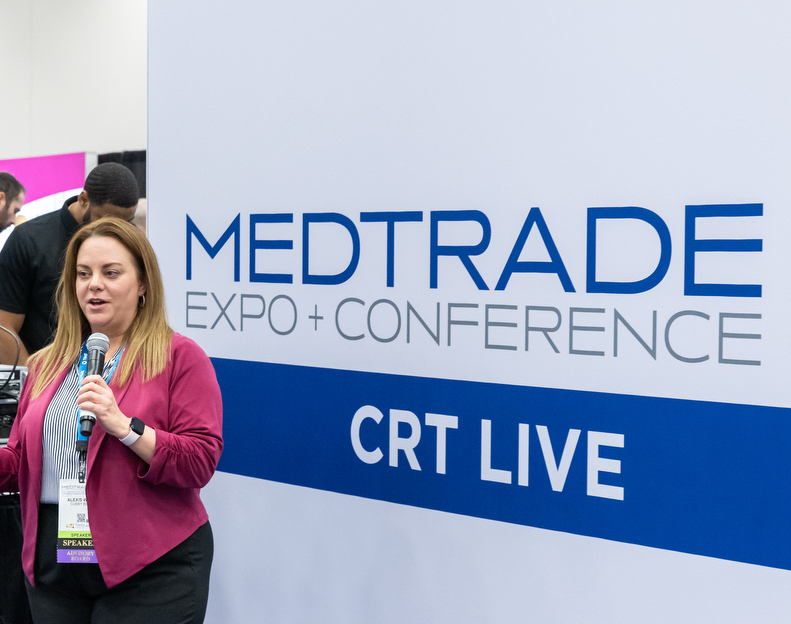 “For many families, these risks become a nightly reality, one that traditional equipment hasn’t been designed to address,” says Alexis Ward (pictured at Medtrade 2025), head of funding and advocacy for Denver-based Cubby Beds, which provides smart safety beds for adults and children with disabilities. “That gap has paved the way for new clinical approaches, new technologies, and new models of partnership between manufacturers and DME providers.”
Medtrade exhibitor Cubby Beds is one of the companies helping to forge these new partnerships. Caregiver-reported findings from recent peer-reviewed research highlight just how impactful specialized safety beds can be for children with complex needs.

Families using Cubby Beds report:
• up to 50% fewer elopement and wandering events;
• sleep duration increasing from four to six hours to eight to 10 hours per night; and
• nighttime wake-ups dropping from five to six to one to two per night.
Better sleep is strongly correlated with improved daytime regulation, reduced aggression and meltdowns, stronger therapy carryover, and lower caregiver burnout. And reductions in elopement and injury risk directly translate into fewer emergency visits, lower long-term costs, and safer home environments.
“Cubby’s design, including tensioned safety walls, entrapment-preventing sheets, a sensory-modulating canopy, mesh and fabric door options, and an FDA-registered framework, reflects an approach grounded in both human-centered design and clinical rigor,” Ward says. “The company is committed to continuous R&D, investing more than $1M in quality improvements, enhanced regulatory compliance, and expanded sensory and safety technology.”
A DME Partnership Model That Solves Real Pain Points
For DME suppliers, Cubby offers turnkey support that drives both operational ease and revenue growth. In an environment where misc code billing, complex LMNs, and payer variability can slow adoption, Cubby’s support infrastructure helps DMEs scale confidently in a high-need, high-impact market.
A Growing Market
Autism prevalence has risen 384% over the past two decades, a trajectory that underscores an urgent and expanding need for pediatric safety solutions. Children with autism often require additional support that extend well beyond sleep solutions.
Research suggests about 30% of children with autism do not develop functional speech and thus may benefit from AAC (augmentative and alternative communication). Studies also show children with autism are significantly more likely than their typically developing peers to experience continence and bladder/bowel challenges.
As more clinicians recognize the link between sleep, behavior, injury prevention, and long-term outcomes, DME providers have a pivotal role to play in bringing this new generation of solutions to families. Safe sleep is not ancillary to care; it is foundational. And the combination of clinical evidence, robust supplier support, and relentless product innovation positions Cubby Beds as a leader redefining what is possible.
Cubby Beds is scheduled to exhibit at Medtrade 2026, scheduled for March 2-4 at the Phoenix Convention Center in Arizona. This article was provided by Cubby Beds and references/footnotes are available upon request. Contact Greg Thompson, editor, at [email protected]