

MOUNTAIN VIEW, CA – Geoff Seyon, co-founder and CEO of Celeritas AI, Inc. (a Medtrade exhibitor) has seen the benefits of stopping claim denials at the source. At a basic level, the benefits are simple: clean claims drive predictable revenue, while denials create compounding operational drag.
“Even in well-run organizations with experienced teams, the process is inherently fragile,” Seyon says. “After customer service reps complete initial order intake, the vast majority of orders (often 95%) still require downstream quality checks for errors or omissions. Even after passing those checks, 35% to 65% of orders may need to be adjusted before a claim is ultimately submitted.”
 Despite that effort, denial rates can still land in the 15% to 20% range – or in the worst cases, exceed 30%. This is not a people problem. It’s a systems problem, and the economics and complexity of the business make perfection nearly impossible through manual processes alone.
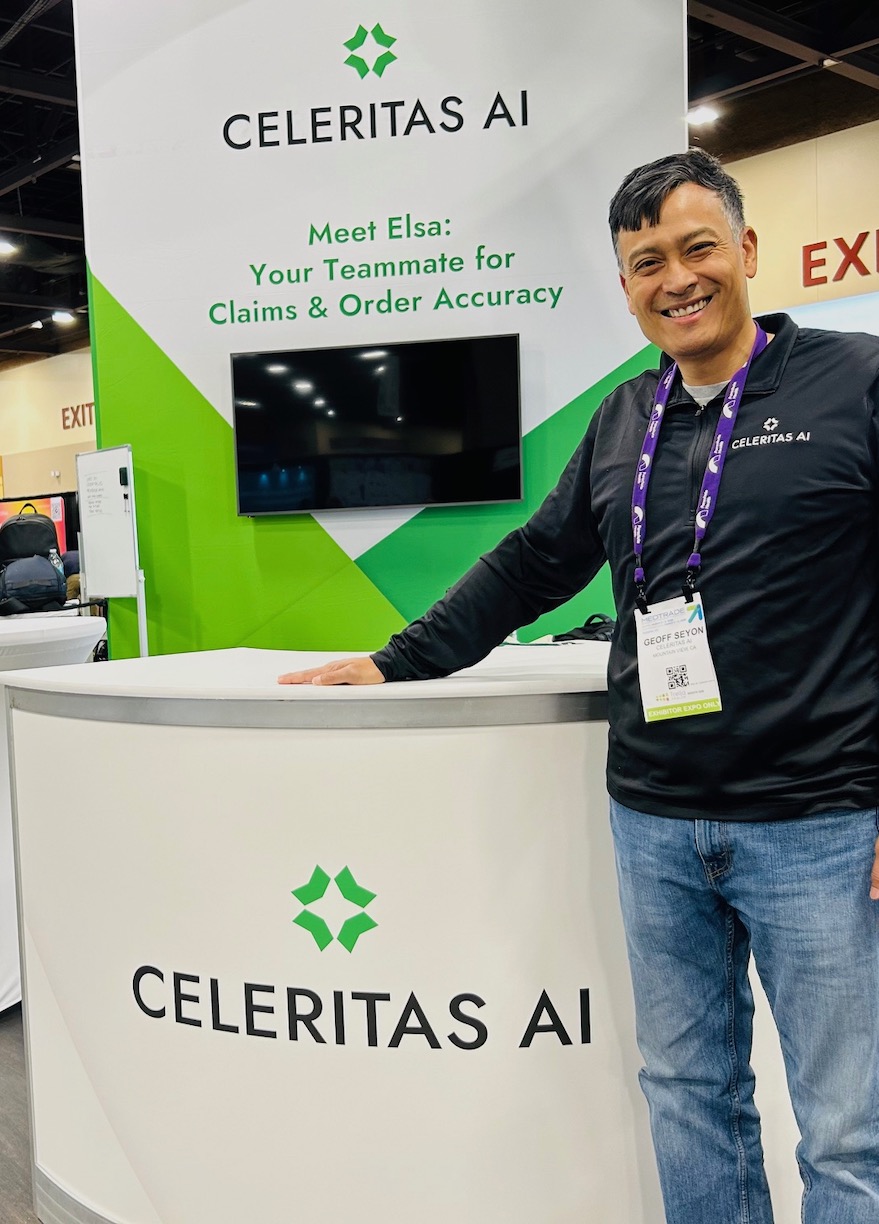
Medtrade Monday sat down with Seyon (pictured at Medtrade 2026) to learn more about the ways in which AI is helping to streamline operations and reduce claim denials.

Medtrade Monday: What are the current challenges in handling orders and claims?
Seyon: A high-performing DME organization requires each team member to process upward of 15 to 16 orders per hour. Yet even well-trained representatives often take weeks or months to ramp to 10 to 11 orders per hour, and that only covers the initial work portion post-intake effort, yet does not include the layered validation and billing steps that must follow.
Medtrade Monday: How would you describe the knowledge burden?
Seyon: The knowledge burden is immense. Teams must navigate thousands of HCPCS codes, tens of thousands of ICD-10 codes, and, in many cases, thousands of payer-specific contracts—each with their own nuanced coverage rules, documentation requirements, and exceptions.
Add to that internal workflows, prior authorizations, and compliance requirements, and you’re effectively asking teams to operate beyond realistic human limits against an encyclopedia of constantly shifting rules. Under those conditions, errors are inevitable. Missing documentation, incorrect modifiers, invalid diagnosis codes, coverage mismatches, and incomplete authorizations are just a few of the issues that can slip through – even in experienced teams.
Medtrade Monday: What types of problems arise once a claim is denied?
Seyon: At that point, the process becomes reactive. Staff must rework documentation, correct errors, and resubmit claims, often involving multiple touchpoints and back-and-forth with payers. This rework can take several times longer than getting the claim right the first time. In fact, it can require nearly seven times the human effort to fix a denied claim versus preventing the error upfront.
Medtrade Monday: What’s the potential impact to the bottom line?
Seyon: The financial impact compounds quickly. A denial doesn’t just add cost—it introduces delays. Organizations may wait 30 days or more just to receive a denial, followed by additional cycles of 30, 60, or even 90 days to resolve and receive payment. Meanwhile, accounts receivable grows, cash flow becomes less predictable, and administrative burden increases across billing, reporting, and reconciliation functions.
Medtrade Monday: What are the consequences of high denial rates?
Seyon: High denial rates can also trigger more frequent audits, pulling senior staff away from productive work and adding further strain to already stretched teams. In contrast, stopping denials at the source fundamentally changes the equation. When claims are clean from the outset, organizations can operate with far greater efficiency, lower cost structures, and more predictable revenue cycles. Cash converts faster, margins improve, and teams can focus on growth rather than rework. This is where modern AI-driven approaches are starting to make a meaningful impact.
 Medtrade Monday: How specifically is your company helping providers?
Seyon: At Celeritas AI, we’ve focused specifically on shifting denial prevention upstream into intake and order curation, where it has the greatest leverage. Our platform, Elsa AITM, acts as an intelligent layer on top of existing systems, helping teams ensure that orders are complete, accurate, and compliant with payer-specific rules before they ever reach submission.
Rather than requiring staff to manually interpret thousands of coverage rules or second-guess documentation requirements, Elsa provides real-time guidance at the point of work, thereby reducing errors before they occur and eliminating unnecessary downstream effort.
Medtrade Monday: What result are you seeing?
Seyon: The result is fewer denials, less rework, and a significantly cleaner path to reimbursement.
Ultimately, preventing denials isn’t just about operational efficiency – it’s about building a scalable business. Organizations that get this right can grow faster on a more stable cost base, improve cash flow, and unlock meaningful gains in profitability. We know this through actual business metrics that we help them monitor, measure, and realize.
Medtrade Monday: What do you say to DME providers who are still hesitant to incorporate AI tools into their business?
Seyon: Hesitation is understandable. This is a mission-critical, highly regulated industry, and most providers have been conditioned to be cautious, especially when it comes to adopting new technology that touches revenue and compliance. That said, hesitation tends to disappear quickly once providers can evaluate AI in a practical, low-risk way. In our experience, nearly every provider who participates in a short Elsa demo opts into a pilot, and a large majority move forward shortly after seeing the system operate within their own environment. Once they can connect the technology directly to their workflows and outcomes, the value becomes tangible.
For providers who are still on the fence, the most effective approach is to start small and stay focused. Rather than attempting a full operational overhaul, begin with a single, high-friction part of the workflow e.g. intake – measure the impact, and expand from there. This allows organizations to validate ROI quickly without introducing unnecessary risk.
Medtrade Monday: What types of adoption patterns are you seeing?
Seyon: AI adoption in DMEPOS is following a familiar pattern. As Crossing the Chasm[1] describes, new technologies are first embraced by early adopters, then validated by early mainstream users before becoming standard. We are now firmly in that early mainstream phase in this industry. Providers are no longer asking if AI will play a role. They are asking when and how to adopt it in a way that delivers real results.
It’s also important to reframe how AI is positioned internally. The most successful implementations treat AI as a layer, not a replacement. It doesn’t require ripping out existing systems or reducing headcount. Instead, it sits on top of current workflows, helping guide decisions, reduce repetitive checks, and improve accuracy at scale.
Medtrade Monday: What’s another barrier to giving AI a try?
Seyon: Another source of hesitation we encounter comes from providers who have experimented with early or poorly designed solutions. Not all AI solutions are created equal, and differences in architecture, data handling, and domain expertise can materially affect outcomes. In some cases, we’ve worked with organizations that needed to reset after an initial misstep. The key is to evaluate solutions carefully, prioritize those built specifically for the DMEPOS environment by ethical, reputable leaders, and focus on measurable performance rather than broad promises.
Ultimately, the decision comes down to timing. The providers who are adopting now are already seeing improvements in efficiency, cost structure, and revenue cycle performance. Those who wait may still adopt later, but increasingly, they’ll be doing so to catch up rather than to lead.